Methylation guide
The methylation cycle explained
Methylation is how your body moves small chemical tags called methyl groups onto DNA, brain messengers, hormones and cell membranes. The methylation cycle is the machinery that makes and recycles those tags. This guide walks through its three linked parts, the gene at each step, and how to check your own variants for free from a 23andMe, AncestryDNA or MyHeritage raw data file.
The methylation cycle at a glance
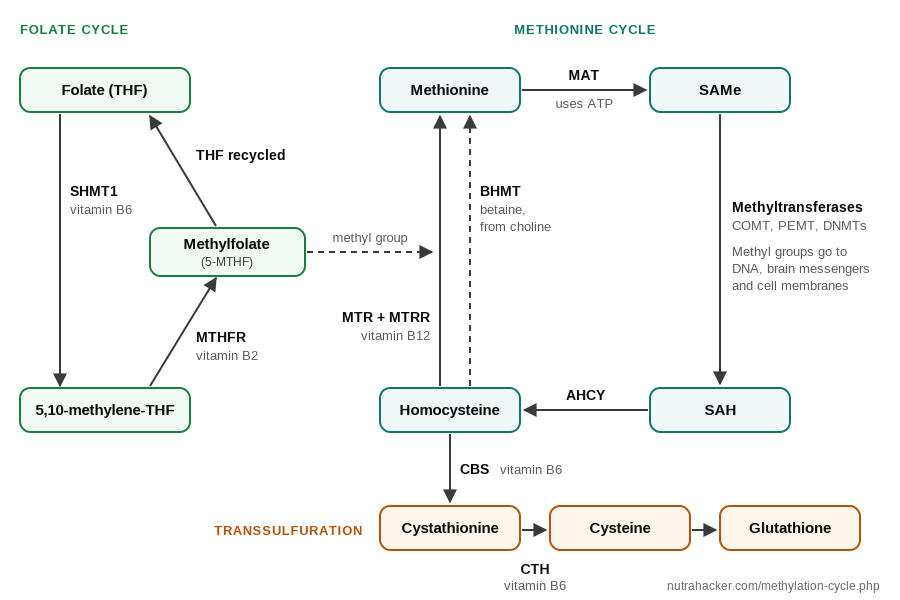
Three things to take from the picture:
- Folate brings methyl groups in. The folate cycle turns folate from food into methylfolate, the form that carries a methyl group.
- SAMe hands them out. The methionine cycle uses that methyl group to make methionine and then SAMe, the molecule almost every methylation reaction in the body draws on.
- Homocysteine is the crossroads. It is what remains after SAMe has given its methyl group away. It is either recycled back to methionine or sent down the transsulfuration pathway to make cysteine and glutathione.
What methylation does
A methyl group is one carbon atom with three hydrogens. Attaching it to another molecule changes how that molecule behaves. Your body uses methylation to:
- Switch genes on and off by tagging DNA, without changing the DNA sequence itself.
- Make and clear brain messengers such as dopamine and adrenaline.
- Build cell membranes, by making phosphatidylcholine.
- Make creatine, which muscles use for energy.
- Process hormones and other compounds, including estrogens and histamine.
Membrane building and creatine synthesis use the largest share of the body's methyl groups, which is why choline and creatine intake affect how hard the cycle has to work.
The three linked parts
1. The folate cycle
Folate from food arrives as tetrahydrofolate (THF). SHMT1 and MTHFD1 load it with a one-carbon unit, and MTHFR converts that into methylfolate (5-MTHF). This step runs in one direction only, which makes MTHFR the gate between folate used for building DNA and folate used for methylation. Synthetic folic acid has to pass through DHFR before it can join the cycle.
2. The methionine cycle
MTR (methionine synthase) takes the methyl group from methylfolate and puts it on homocysteine, making methionine. It needs vitamin B12 to do so, and MTRR keeps that B12 in working order. Methionine is then turned into SAMe. Methyltransferase enzymes such as COMT and PEMT take the methyl group from SAMe and attach it to their targets. What is left becomes SAH and then homocysteine, and the cycle starts again.
The liver and kidneys have a second way to recycle homocysteine: BHMT uses betaine, which the body makes from choline, instead of methylfolate. That is why choline matters more when the folate route is slow.
3. The transsulfuration pathway
Homocysteine that is not recycled leaves the cycle through CBS, which needs vitamin B6. Two steps later it has become cysteine, the building block the body uses to make glutathione, its main antioxidant. When SAMe is plentiful it speeds CBS up, so more homocysteine drains this way.
The main methylation genes
| Gene | What it does | Needs | Common variant |
|---|---|---|---|
| MTHFR | Makes methylfolate | Riboflavin (B2) | C677T (rs1801133), A1298C (rs1801131) |
| MTR | Recycles homocysteine to methionine | Vitamin B12, methylfolate | A2756G (rs1805087) |
| MTRR | Keeps MTR's vitamin B12 active | Riboflavin (B2) | A66G (rs1801394) |
| BHMT | Second route from homocysteine to methionine | Betaine (from choline), zinc | – |
| CBS | Sends homocysteine towards cysteine and glutathione | Vitamin B6 | – |
| COMT | Uses SAMe to clear dopamine, adrenaline and catechol estrogens | Magnesium, SAMe | Val158Met (rs4680) |
| PEMT | Uses SAMe to make phosphatidylcholine | SAMe | – |
MTHFR C677T has the best evidence: two copies cut the enzyme's activity to about 30% of normal and tend to raise homocysteine when folate or riboflavin is low. The common variants in MTR, MTRR and the other genes have smaller effects, and studies do not always agree on them. See the free MTHFR analysis and free COMT analysis pages for how to read those two in your own file.
How to check your methylation genes for free
If you have tested with 23andMe, AncestryDNA or MyHeritage, the common variants in these genes are already in your raw data file. NutraHacker's free Detoxification and Methylation Report reads them for you:
- Download your raw data file: 23andMe, AncestryDNA, MyHeritage.
- Unzip it and upload the .txt or .csv file. It takes about 3 minutes.
- Open the Detoxification and Methylation Report and the Detox Supplement Interactive Tool in the Report Center.
The free report covers 58 methylation and detox SNPs in genes including MTHFR, MTR, MTRR, CBS and COMT. For each one you see your genotype, what the gene does, what your result means and how common it is. The interactive tool then turns your results into supplement recommendations: what to take and what to avoid.
Looking at the cycle as a whole. One variant rarely tells the story. The optional Complete Mutation Nutrition Report ($37 one time) includes Your pathway pattern, which checks whether your MTHFR, MTR and other folate and methionine variants stack up along linked steps, compared with other NutraHacker users.
What your genes cannot tell you
A genetic report shows which versions of these enzymes you inherited. It does not measure how the cycle is running today, which also depends on what you eat, your B vitamin levels, kidney function, thyroid function, alcohol and some medicines.
- The functional check is a blood test. Homocysteine, usually with folate and vitamin B12, shows whether the cycle is under strain. Most laboratories report 5 to 15 µmol/L as the usual range.
- "Undermethylator" and "overmethylator" are not medical diagnoses. These labels are popular online, but there is no accepted test or definition behind them.
- MTHFR variants on their own are not considered a cause of blood clots, and testing them to explain clots is not recommended.
- Epigenetic tests measure something else. "DNA methylation" and biological age tests read the methyl tags on your DNA at one moment. They do not look at the genes described here.
Nutrients the cycle depends on
- Folate, from leafy greens and legumes, or as methylfolate or folic acid.
- Vitamin B12, which MTR needs to recycle homocysteine.
- Vitamin B6, for SHMT1 and for both steps of the transsulfuration pathway.
- Riboflavin (B2), which MTHFR and MTRR need; in people with two copies of C677T, a low dose lowered homocysteine.
- Choline and betaine, which supply the BHMT route.
Talk to your doctor before changing supplements, especially in pregnancy or if you take medication. For everything else you can do with your file, see raw DNA analysis.
Frequently asked questions
What is the methylation cycle in simple terms?
It is the set of linked reactions your cells use to make and recycle methyl groups, small chemical tags made of one carbon and three hydrogens. Folate and vitamin B12 feed methyl groups in, a molecule called SAMe hands them out, and what is left over, homocysteine, is either recycled or broken down.
Which genes are in the methylation cycle?
The best known are MTHFR, MTR, MTRR, BHMT, SHMT1 and MTHFD1 in the folate and methionine cycles, CBS in the transsulfuration pathway, and methyl-using enzymes such as COMT and PEMT. MTHFR gets the most attention, but it is one step among many.
Can I check my methylation genes from 23andMe or AncestryDNA raw data?
Yes. The raw data file from 23andMe, AncestryDNA or MyHeritage contains the common variants in MTHFR, MTR, MTRR, COMT and CBS. Upload it to NutraHacker and the free Detoxification and Methylation Report reads them for you.
Is a genetic methylation report the same as a methylation test?
No. A genetic report shows which enzyme variants you inherited. It does not measure how well your methylation cycle is working today. A homocysteine blood test, with folate and B12 levels, is the usual way to check that. Epigenetic "DNA methylation" or biological age tests measure something different again.
Does an MTHFR variant mean I am a poor methylator?
Not on its own. MTHFR variants are very common, and diet, B vitamin status and the other genes in the cycle all matter. Many people with two copies of C677T have normal homocysteine. Genes show a tendency; a blood test shows what is happening.
Which vitamins does the methylation cycle need?
Folate, vitamin B12, vitamin B6 and riboflavin (B2) are the main ones, with choline and betaine supplying a second route for recycling homocysteine. Talk to your doctor before changing supplements, especially in pregnancy.